
Grooved Pins DIN 1471–1475
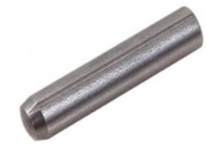
A grooved pin is a solid cylinder with three equally spaced longitudinal grooves pressed into it. The grooving raises the diameter locally, so when the pin is driven into a plain drilled hole the raised material deforms elastically and grips the wall - a low-cost fixing needing no reaming. We supply the DIN groove forms in mild steel, available across a range of metric and inch sizes, with stainless steel versions also available.
Also known as: groove pin, grooved dowel, taper groove pin, half length groove pin, din 1471, din 1472, din 1473, din 1474, din 1475, iso 8744, iso 8740.
Groove form reference
| Groove form | DIN | ISO equivalent |
|---|---|---|
| Parallel groove with pilot | DIN 1470 | ISO 8739 |
| Full-length taper groove | DIN 1471 | ISO 8744 |
| Half-length taper groove | DIN 1472 | ISO 8745 |
| Full-length parallel groove | DIN 1473 | ISO 8740 |
| Half-length reverse taper groove | DIN 1474 | ISO 8741 |
| Third-length centre groove | DIN 1475 | ISO 8742 |
| Half-length centre groove | — | ISO 8743 |
Materials & strength
Plain drilled hole
The hole is drilled at the pin's nominal diameter - no reaming or special preparation. The elastic deformation of the raised groove edges provides the frictional grip.
Form follows function
Full-length grooves suit through-fixings such as shaft drive pins and keying duties; half-length and centre-groove forms put the grip where the joint needs it - as stop pins, hinge pins or guide pins with a free-turning portion.
Length measurement
Pin length is specified as the nominal body length - state the length with the diameter and groove form when ordering.
Related forms and grooved studs
Annular-groove variants, including the DIN 1469 pattern, are available on request. Grooved studs - round head DIN 1476 and countersunk DIN 1477 - are a related product available to order in diameters from 1.4mm to 6mm.
Related specificationsHow does a grooved pin grip without a spring section?
Pressing the grooves displaces material sideways, raising three ridges above the nominal diameter. Driving the pin into a nominal-size hole squeezes those ridges back, and their elastic push against the wall holds the pin.
Which groove form do I need?
Match the form to where grip is wanted: full-length forms for maximum engagement, half-length forms where one end must stay free or enter a clearance hole, centre-groove forms for pivot and stop duties. The table on this page maps each DIN form to its ISO equivalent.
Are grooved pins reusable?
The grip relies on the raised groove edges, which take a set after fitting, so a removed pin gives a reduced grip on refit. For assemblies that come apart regularly, a spring pin or dowel is the better choice.
Can these be supplied in stainless steel?
Standard production is mild steel. Stainless steel versions are available — send us your requirement.
Need DIN 1471–1475 in a non-standard size or material?
Send us your drawing — specials quoted within one working day.