
DIN 985 Nylon Insert Nuts
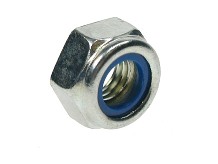
DIN 985 covers standard-height nylon insert locking nuts — the familiar nylon insert, with a polymer insert that grips the mating thread to resist loosening. We supply DIN 985 nylon insert nuts in steel property classes 8 and 10 and stainless steel A2 and A4, across a wide range of metric sizes.
Also known as: Nyloc.
DIN 985 dimensions
| Diameter | Pitch | Depth of Nut | Across Flats |
|---|---|---|---|
| M3 | 0.5mm | 4mm | 5.5mm |
| M4 | 0.7mm | 5mm | 7mm |
| M5 | 0.8mm | 5mm | 8mm |
| M6 | 1.0mm | 6mm | 10mm |
| M7 | 1.0mm | 7.5mm | 11mm |
| M8 | 1.25mm | 8mm | 13mm |
| M10 | 1.5mm | 10mm | 17mm |
| M12 | 1.75mm | 12mm | 19mm |
| M14 | 2mm | 14mm | 22mm |
| M16 | 2mm | 16mm | 24mm |
| M18 | 2.5mm | 18.5mm | 27mm |
| M20 | 2.5mm | 20mm | 30mm |
| M22 | 2.5mm | 22mm | 32mm |
| M24 | 3.0mm | 24mm | 36mm |
| M27` | 3.0mm | 27mm | 41mm |
| M30 | 3.5mm | 30mm | 46mm |
| M33 | 3.5mm | 33mm | 50mm |
| M36 | 4mm | 36mm | 55mm |
| M39 | 4mm | 39mm | 60mm |
| M42 | 4.5mm | 42mm | 65mm |
| M45 | 4.5mm | 45mm | 70mm |
| M48 | 5mm | 48mm | 75mm |
| M52 | 5mm | 52mm | 80mm |
| M56 | 5.5mm | 56mm | 85mm |
| M60 | 5.5mm | 60mm | 90mm |
| M64 | 6mm | 64mm | 95mm |
Materials & strength
Nylon insert locking
A polyamide collar grips the bolt thread and resists loosening under vibration, with minimal effect on the mating thread.
Steel grades 8 & 10
Property class 8 is the usual mate for grade 8.8 bolts, with class 10 used against 10.9 bolts so the nut matches the bolt strength.
Stainless steel A2 & A4
A2 gives good general corrosion resistance; A4 adds molybdenum for improved resistance to chlorides and marine atmospheres.
What is a DIN 985 nylon insert nut used for?
DIN 985 nylon insert nuts are vibration-resistant locking nuts used in automotive, machinery and general industrial assemblies where a standard nut could work loose. The nylon insert creates friction against the bolt thread, giving strong resistance to backing off under vibration and dynamic loads.
What is the difference between DIN 985 and DIN 982 nylon insert nuts?
DIN 985 is the standard nylon insert pattern in trade use; within the DIN system it is the low (thin) form, with DIN 982 the high (thick) form with a taller body and more engaged thread. Both lock the same way through the nylon insert; DIN 982 is chosen where the extra height is specified or greater thread engagement is wanted.
How does a nylon insert nut work?
The nut carries an unthreaded nylon collar above its metal threads. As the bolt passes through, it presses into the nylon, which grips the thread flanks and creates friction that resists rotation, so the nut holds its position under vibration.
Can nylon insert nuts be reused?
Reusability is condition-dependent: the insert loses some grip each time the nut is run down the thread, and there is no universal cycle count. Many specifiers fit a new nut once one has been removed, and a nut with a worn or damaged insert should be replaced.
What materials are DIN 985 nuts available in?
DIN 985 nuts are available in steel grades 8 and 10 and stainless steel A2 and A4 across a wide range of metric sizes. A2 suits general corrosion resistance, with A4 the usual choice where chlorides or marine exposure are involved.
Are nylon insert nuts suitable for high temperatures?
The locking element is nylon, so service-temperature limits depend on the insert; elevated temperatures reduce locking performance. Where temperature rules out a nylon insert, an all-metal locking nut such as DIN 980 is usually the better choice - send us your requirement and we can identify a suitable product.
Need DIN 985 in a non-standard size or material?
Send us your drawing — specials quoted within one working day.