
DIN 934 Hexagon Full Nuts
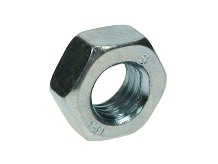
DIN 934 covers hexagon full nuts — the standard general-purpose nut used throughout engineering. We supply DIN 934 nuts in steel property classes 8, 10 and 12, stainless steel A2 and A4, brass and nylon, across a wide range of metric sizes. Send us your requirement and we'll quote within one working day.
DIN 934 dimensions
| Diameter | Pitch | Depth of Nut | Across Flats |
|---|---|---|---|
| M3 | 0.5mm | 2.4mm | 5.5mm |
| M4 | 0.7mm | 3.2mm | 7mm |
| M5 | 0.8mm | 4mm | 8mm |
| M6 | 1.0mm | 5mm | 10mm |
| M7 | 1.0mm | 5.5mm | 11mm |
| M8 | 1.25mm | 6.5mm | 13mm |
| M10 | 1.5mm | 8mm | 17mm |
| M12 | 1.75mm | 10mm | 19mm |
| M14 | 2mm | 11mm | 22mm |
| M16 | 2mm | 13mm | 24mm |
| M18 | 2.5mm | 15mm | 27mm |
| M20 | 2.5mm | 16mm | 30mm |
| M22 | 2.5mm | 18mm | 32mm |
| M24 | 3.0mm | 19mm | 36mm |
| M27 | 3.0mm | 22mm | 41mm |
| M30 | 3.5mm | 24mm | 46mm |
| M33 | 3.5mm | 26mm | 50mm |
| M36 | 4mm | 29mm | 55mm |
| M39 | 4mm | 31mm | 60mm |
| M42 | 4.5mm | 34mm | 65mm |
| M45 | 4.5mm | 36mm | 70mm |
| M48 | 5mm | 38mm | 75mm |
| M52 | 5mm | 42mm | 80mm |
| M56 | 5.5mm | 45mm | 85mm |
| M60 | 5.5mm | 48mm | 90mm |
| M64 | 6mm | 51mm | 95mm |
| M68 | 6mm | 58mm | 100mm |
| M72 | 6mm | 58mm | 105mm |
| M76 | 6mm | 61mm | 110mm |
| M80 | 6mm | 64mm | 115mm |
| M90 | 6mm | 72mm | 130mm |
| M100 | 6mm | 80mm | 145mm |
| M110 | 6mm | 88mm | 155mm |
Materials & strength
Steel property classes 8, 10 & 12
Class 8 covers general and structural bolting with grade 8.8 bolts; class 10 mates 10.9 bolts and class 12 mates 12.9 bolts.
Stainless steel A2 & A4
A2 gives good general corrosion resistance; A4 adds molybdenum for improved resistance to chlorides and marine atmospheres.
Brass & nylon
Brass offers corrosion resistance and electrical conductivity; nylon nuts are light, insulating and chemically resistant, suited to light-duty fixings.
What is a DIN 934 hexagon full nut?
DIN 934 is the familiar standard hexagon full nut used for general bolting, machine assembly and structural work. It is the default mate for hexagon bolts, set screws and studding.
What is the difference between DIN 934 and ISO 4032?
The standards are closely related, although dimensional or technical differences may exist - the across-flats width differs at M10, M12, M14 and M22, and nut heights differ over part of the range. Our table lists the DIN 934 values. DIN 934 also covers fine-pitch threads, which in the ISO system relate to the ISO 8673 family, so ISO 4032 alone is not a complete successor. If your drawing specifies ISO 4032, send us the requirement and we can identify the appropriate product.
Which nut grade goes with which bolt grade?
As a general rule the nut property class is matched to the bolt class - class 8 nuts with 8.8 bolts, class 10 with 10.9, and class 12 with 12.9. This keeps the nut from being the weaker element in the joint; tell us the bolt specification and we can match the nut.
What is the difference between a full nut and a thin nut?
A full nut such as DIN 934 is the standard height for general clamping, while thin nuts such as DIN 439 are roughly half height and are typically used as counter (jam) nuts or where space is limited. For most load-carrying joints the full nut is the usual choice.
What materials are DIN 934 nuts available in?
DIN 934 nuts are available in steel grades 8, 10 and 12, stainless steel A2 and A4, brass and nylon across a wide range of metric sizes. Brass and nylon suit corrosion-sensitive, decorative or electrical applications where a hardened steel nut is not wanted.
Need DIN 934 in a non-standard size or material?
Send us your drawing — specials quoted within one working day.