
DIN 546 Slotted Round Nuts
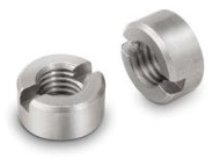
We supply Slotted Round Nuts to DIN 546
DIN 546 dimensions
| Diameter | Pitch | Body Diameter | Body Depth | Slot Width |
|---|---|---|---|---|
| M2 | 0.4mm | 4.5mm | 2.0mm | 1.0mm |
| M2.5 | 0.45mm | 5.5mm | 2.2mm | 1.2mm |
| M3 | 0.5mm | 6.0mm | 2.5mm | 1.2mm |
| M4 | 0.7mm | 8.0mm | 3.5mm | 1.4mm |
| M5 | 0.8mm | 9.0mm | 4.2mm | 2.0mm |
| M6 | 1.0mm | 11.0mm | 5.0mm | 2.5mm |
| M8 | 1.25mm | 14.0mm | 6.5mm | 3.0mm |
| M10 | 1.5mm | 18.0mm | 8.0mm | 3.5mm |
Materials & strength
Round body, slotted face
The cylindrical form fits counterbores and recesses, and the face slot lets it be driven where there is no room for a spanner.
What is a DIN 546 slotted round nut?
DIN 546 covers small slotted round nuts: cylindrical nuts with a single slot across the face, turned with a flat-blade screwdriver. The round body sits neatly in counterbored or recessed positions where a hexagon nut would not fit or would spoil the appearance.
How do you tighten a slotted round nut?
With a flat-blade screwdriver in the face slot, which suits recessed positions a spanner cannot reach. They are typically used in locating and retaining applications on instruments, trim and small assemblies.
What is the difference between DIN 546 and DIN 1804?
DIN 546 nuts are small screwdriver-slotted nuts, while DIN 1804 covers much larger slotted ring nuts driven by a hook spanner, used on machine spindles and shafts. The two serve different size ranges and duties.
Need DIN 546 in a non-standard size or material?
Send us your drawing — specials quoted within one working day.