
DIN 439 Hexagon Thin Nuts
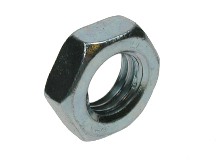
DIN 439 covers hexagon thin nuts, often called half nuts or lock nuts — used as a jam nut against a full nut, or where a full-height nut won't fit. We supply DIN 439 thin nuts in steel property class 4 and stainless steel A2 and A4, across a wide range of metric sizes.
DIN 439 dimensions
| Diameter | Pitch | Depth of Nut | Across Flats |
|---|---|---|---|
| M2 | 0.4mm | 1.2mm | 4.0mm |
| M2.5 | 0.45mm | 1.6mm | 5.0mm |
| M3 | 0.5mm | 1.8mm | 5.5mm |
| M4 | 0.7mm | 2.2mm | 7mm |
| M5 | 0.8mm | 2.7mm | 8mm |
| M6 | 1.0mm | 3.2mm | 10mm |
| M8 | 1.25mm | 4.0mm | 13mm |
| M10 | 1.5mm | 5mm | 17mm |
| M12 | 1.75mm | 6mm | 19mm |
| M14 | 2mm | 7mm | 22mm |
| M16 | 2mm | 8mm | 24mm |
| M18 | 2.5mm | 9mm | 27mm |
| M20 | 2.5mm | 10mm | 30mm |
| M22 | 2.5mm | 11mm | 32mm |
| M24 | 3.0mm | 12mm | 36mm |
| M27 | 3.0mm | 13.5mm | 41mm |
| M30 | 3.5mm | 15mm | 46mm |
| M33 | 3.5mm | 16.5mm | 50mm |
| M36 | 4mm | 18mm | 55mm |
| M39 | 4mm | 19.5mm | 60mm |
| M42 | 4.5mm | 21mm | 65mm |
| M45 | 4.5mm | 22.5mm | 70mm |
| M48 | 5mm | 24mm | 75mm |
| M52 | 5mm | 26mm | 80mm |
| M56 | 5.5mm | 28mm | 85mm |
| M60 | 5.5mm | 30mm | 90mm |
Materials & strength
Half-height form B
Roughly half the height of a full nut, with chamfered faces (form B), suiting counter-locking and space-limited assemblies.
Steel grade 4 & stainless A2/A4
Grade 4 steel covers general counter-nut duties; A2 and A4 stainless cover corrosive environments, with A4 preferred for chloride or marine exposure.
What is a DIN 439 locknut?
DIN 439 covers hexagon thin nuts, often called half nuts or lock nuts, at roughly half the height of a standard full nut. Our range is form B, the chamfered pattern.
What are thin nuts used for?
The classic use is as a counter (jam) nut tightened against a full nut so the pair resist working loose, and they also suit assemblies where a full-height nut does not fit. Thin nuts have reduced loadability, so they are assembled together with a standard nut rather than used as the sole load-carrying nut.
Can I use a thin nut on its own for a loaded joint?
Thin nuts have less engaged thread than a full nut, so for load-carrying joints a full nut such as DIN 934 is the usual choice. Thin nuts are generally treated as locking or spacing components rather than the primary nut.
What is the difference between DIN 439 and DIN 936?
The standards are closely related, although dimensional or technical differences may exist between the two thin-nut patterns at some sizes. If your drawing specifies DIN 439 or DIN 936, send us the requirement and we can identify the appropriate product.
What materials are DIN 439 nuts available in?
DIN 439 thin nuts are available in steel grade 4 and stainless steel A2 and A4 across a wide range of metric sizes. Stainless suits damp or corrosive conditions.
Need DIN 439 in a non-standard size or material?
Send us your drawing — specials quoted within one working day.